
Note
Go to the end to download the full example code.
Figure Size and spacing#
Unlike other matplotlib plotting libraries, Marsilea gives you fine control over the size of the plot and the main canvas.
You don’t have to suffer from fixing the figure size and try to maintain the ratio among plots.
Note
The unit of the size is in inches.
import numpy as np
import marsilea as ma

data = np.random.randint(0, 10, (10, 10))
The size main canvas can be controlled via the width and height parameters.
h = ma.Heatmap(data, width=1, height=1.5)
h.add_title(top="width=1", left="height=1.5")
h.render()

<marsilea.heatmap.Heatmap object at 0x72cbe1c39a00>
Let’s switch the width and height.
h = ma.Heatmap(data, width=2, height=1)
h.add_title(top="width=2", left="height=1")
h.render()

<marsilea.heatmap.Heatmap object at 0x72cbe29bad80>
The size of the plotter can be controlled via the size parameter when you add to the main canvas.
blue = ma.plotter.ColorMesh(data[0], cmap="Blues", label="size=0.1")
green = ma.plotter.ColorMesh(data[1], cmap="Greens", label="size=0.2")

h = ma.Heatmap(data, width=1, height=1)
h.add_top(blue, size=0.1, pad=0.05)
h.add_top(green, size=0.2, pad=0.05)
h.render()

<marsilea.heatmap.Heatmap object at 0x72cbe2e5cc80>
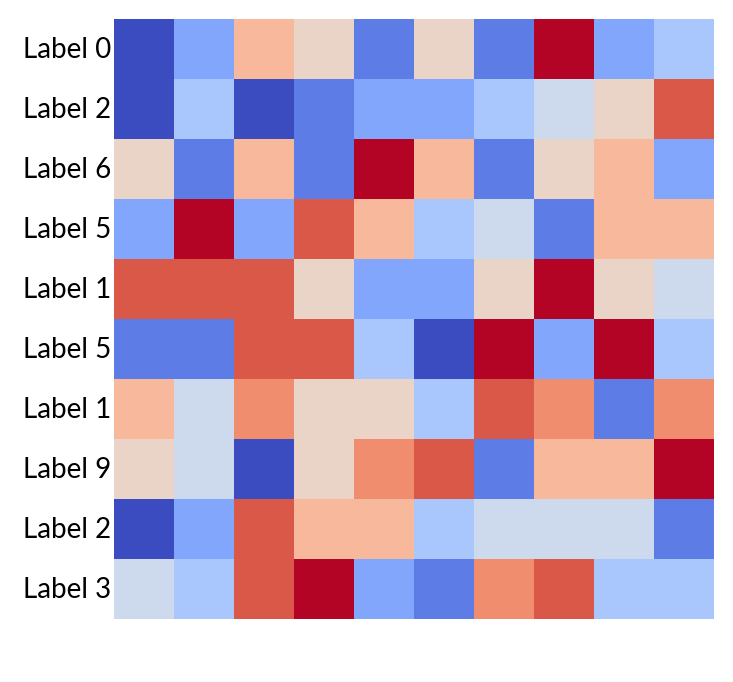
The size of text in Marsilea is automatically adjusted based on the content. But you can also set the size explicitly.
text = ma.plotter.Labels([f"Label {i}" for i in data[0]])

h = ma.Heatmap(data, width=3, height=3)
h.add_left(text)
h.render()
<marsilea.heatmap.Heatmap object at 0x72cbe1c3a1e0>
Total running time of the script: (0 minutes 0.277 seconds)